


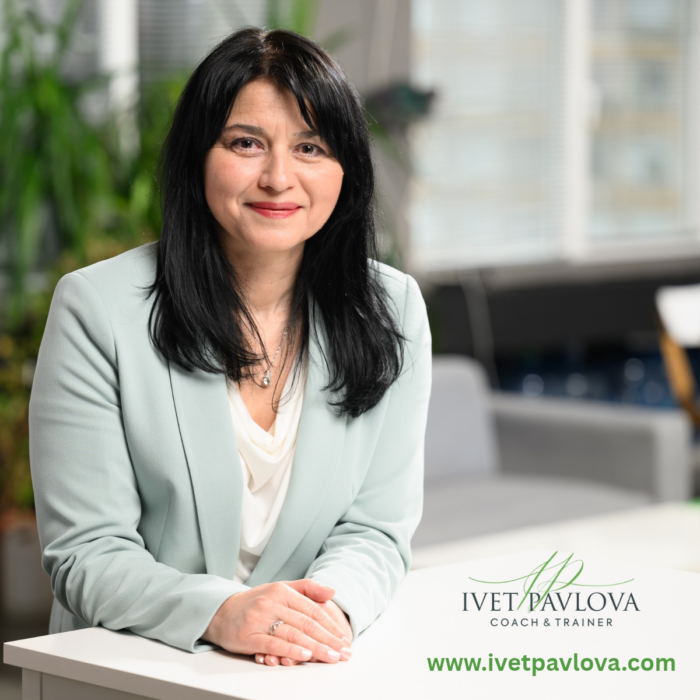
Written by Ivet Pavlova, ICF PCC, NLP Somatic Coach, Business, Leadership and Life Balance Coach
Business development is changing rapidly. New technologies, including AI, create opportunities for starting and growing businesses much faster than before.
But although technology can help us develop products, improve processes and grow sales, our leadership skills, communication, relationships and ability to work with people remain important for building a sustainable business.
From my experience in business and coaching, I see that founders and leaders often need to develop personally and professionally while their businesses are growing. Sometimes the business develops faster than their leadership skills, or they face challenges they have never experienced before.
Coaching is one of the ways to support this development.
In this article, I explain what coaching is, how it works, what different types of coaching exist and how coaching differs from mentoring, consulting, therapy, and training. I will also share my approach to coaching and how I work with founders, leaders and other people who want to make changes in their professional or personal lives.
1. What Is Coaching and How Does It Work?
The International Coaching Federation (ICF) (ICF is the professional organization that develops coaching standards, ethical guidelines and professional credentials to support the quality of coaching services.) gives the following definition of coaching:
“Partnering with clients in a thought-provoking and creative process that inspires them to maximize their personal and professional potential.”
How does this happen?
It happens by asking questions.
We, as professional coaches, are trained to ask high-quality questions. In professional coaching, we don’t give advice.
Why Do Coaches Ask Questions Instead of Giving Advice?
Because nobody knows better than you what your needs, values, temperament and obstacles are. Nobody knows your dreams, goals, desires, limitations and the circumstances in which you operate better than you do.
Of course, there are moments when we need advice or new knowledge, but quite often advice doesn’t work for us, and we feel resistance inside. Or, in some discussions, we discover that we already have the knowledge but don’t use it, and even find it difficult to do so.
For example:
Remember a moment when you knew what you should do but couldn’t do it, or when you had just learned something new but couldn’t implement it, and you shared this with a friend or someone with specific expertise.
When they started giving you advice like “You just need to do it,” “Do this and this,” “Just calm down,” or “Don’t do this,” what happened inside you?
Did you feel resistance to what they said? Did you start bringing arguments against their advice, trying to defend yourself or prove that you were right? Or did you start explaining why you hadn’t done it yet and how difficult it was?
In many cases, this is our usual response to advice in similar situations. And this is normal. As humans, we need to grow and find our own way of doing things. This is a basic human need.
That is why coaching is so valuable in such cases. By asking questions, we as professional coaches help clients connect with their own wisdom and talents, gain more clarity and make decisions based on their own values, needs, desires and goals, while considering how these decisions will impact their lives and relationships with the people around them.
Sometimes clients specifically want to learn from my experience as a coach or hear my professional opinion. I can provide that, but first I clarify what they need and explain that I am temporarily moving from coaching into a consulting or mentoring role.
What else does coaching give you that other people cannot always provide fully?
A safe, confidential space, without judgment, criticism or other forms of alienating communication.
What Are the Benefits of a Safe and Confidential Coaching Space?
In this space, you can hear your own thoughts, reflect on them and take your lessons from the experience through open, empathic communication, where you can feel fully understood, heard and supported.
The level of listening skills we develop as professional coaches is difficult to find in usual conversations, where emotions and different interests are often involved.
The coach’s interest is to support you in the best possible way for you specifically, taking into account the way you think, feel and what you need to change.
Why Are Coaching Questions So Powerful?
I once asked one of my clients, a CEO of a medium-sized company:
“What is the most valuable thing for you from our coaching partnership?”
He answered:
“Your questions are very valuable because they are unbiased, objective, asked from the perspective of an outside observer. I am involved in my situations, and I can’t always ask myself the right questions. But in order to have the right answers, we need to ask the right questions – which is what you do as a coach.”
2. What Is NLP Coaching and How Does It Work?
NLP is a methodology created by John Grinder and Richard Bandler in the 1970s – an approach for improving communication and enhancing personal development. This approach continued to develop over the years and is integrated into the coaching educational programs of some coaching schools accredited by ICF.
This methodology explores how we as humans perceive the information that comes to us, how we process it and how we react. It also explores the creation of habits, strategies for behavior and what helps us create better results and achieve goals by opening our full potential.
For me, NLP is a methodology that explains how to build good relationships, improve our level of wellness and achieve excellent professional results, and provides tools that help people transform in order to achieve those results.
How Is Neuro-Linguistic Programming (NLP) Integrated into Coaching?
Coaching gives the structure of the session and the process from the beginning to the end of the session. The coaching discussion, through the coach’s presence and questions, provides the space and the vehicle that help the client gain awareness, see the missing parts of their puzzle and assess the changes they have experienced during the session.
NLP provides tools that can be used in the middle part of the session to work with patterns, limiting beliefs, negative feelings, fears or other inner barriers that don’t serve clients well in achieving what they want, and to help them choose what other patterns, beliefs and feelings they would prefer to develop as part of who they are.
Why?
Because much of our behavior is influenced by unconscious patterns and automatic responses that we have developed over the years. Through NLP methodology, we can explore these patterns and work on changing those that no longer serve us well, replacing them with others that support us better.
How Can NLP Help Change Limiting Beliefs and Patterns?
I often explain this by comparing it with the programs we use on our computers. When a program we have used for years no longer serves our needs, and a new, better version becomes available, we uninstall the old version and install the new one.
In a similar way, through NLP tools, we work with old beliefs and patterns and help clients develop and integrate new ones that serve them better. Of course, the human mind is much more complex than a computer, but this comparison helps explain the process of change.
For example:
At the beginning of their entrepreneurial journey, many people have difficulties receiving money and selling their services at the price they want.
Sometimes these difficulties are connected with unconscious beliefs about money, which may have developed through their childhood experiences or later in life.
So, we explore these beliefs through NLP tools to understand what the client believes about money and whether these beliefs prevent them from receiving the money they want for the services they provide.
When we identify a limiting belief, the client chooses what other belief, which we call an empowering belief, they would prefer to develop instead. Then, through NLP exercises, we work on transforming the old belief and integrating the new one into the client’s thinking and behavior.
Here, you need to pay attention to something important – it is the choice of the client, not the coach.
That is why, even during the process of NLP transformation, the coach continues to use questions rather than giving advice about what the client should believe or how they should think.
The client makes their own choices and participates voluntarily in the exercises. As coaches, we are also responsible for explaining the process, respecting the client’s boundaries and ensuring that the methods we use are appropriate for their needs and within our professional competencies.
This way, we can integrate NLP tools into the coaching process while following professional coaching standards and ethics.
3. What Are the Different Types of Coaching?
I will explore this through 3 different perspectives: The professional direction of support, the depth of the support, and the number of participants
Types of Coaching Based on Professional and Personal Goals
There are different types of coaching depending on the professional or personal area in which people need support.
- Business coaching focuses on challenges related to developing and managing a business, making decisions, setting goals and navigating different stages of business growth.
However, from my observations, professionals who call themselves business coaches may focus on quite different aspects of business development. Some focus mainly on marketing, increasing sales and scaling the business. Others work with founders on building strong business foundations, clarifying the business direction, developing products and services, improving organizational structure, preparing the business for growth and developing the founder’s mindset.
My business coaching practice is mainly focused on the second approach, helping founders build and develop their businesses by addressing both business challenges and the personal barriers that may prevent them from achieving their goals.
- Leadership coaching supports people in developing their leadership capabilities, communication, decision-making, delegation and relationships with their teams.
Some leadership coaches focus mainly on the individual development of the leader, while others also help leaders improve team collaboration and effectiveness.
My practice includes both, with additional specialization in helping founders navigate conflicts with their co-founders or cope with the aftermath of a painful co-founder separation.
- Executive coaching generally focuses on the professional development of executives and senior leaders, including the challenges and responsibilities associated with their roles.
This is also part of my coaching practice when I work with founders and executives of medium-sized companies.
- Life coaching addresses personal goals, decisions, relationships, habits and other areas of life in which people want to make changes.
My life coaching practice is mainly focused on helping founders and leaders balance business growth and leadership development with being present at home, improving communication with the people they love, having time for themselves, taking care of their energy and wellbeing, and experiencing greater fulfillment in life.
- Wellness coaching focuses on supporting people in developing habits and behaviors related to their wellbeing.
As I started my entrepreneurial journey as a wellness consultant before becoming a coach, I have carried my passion for wellness into my coaching practice as part of life balance coaching.
- Relationship coaching focuses on improving relationships between life partners, resolving difficulties between them or helping people prepare for choosing a suitable partner.
- Other types of coaching include parenting coaching, which supports people in developing their parenting skills and relationships with their children, and career coaching, which helps people explore career directions, make professional decisions and navigate career changes, etc.
Over the years, I have developed a holistic approach that combines business, leadership and life balance coaching because I believe these three areas are deeply interconnected.
How Are Business, Leadership and Life Balance Coaching Connected?
What happens in one area inevitably influences the others. Challenges in leadership can affect business performance, while difficulties in business can impact the way we lead, increase our stress levels, affect our communication, reduce our effectiveness, increase working hours and leave us with less time to rest and rejuvenate. All of this can affect our wellbeing, relationships and personal lives.
And vice versa – the way we feel and function in our personal lives can also influence how we lead and manage our businesses.
That is why, in my coaching practice, I look at these areas together rather than treating them as separate parts of a person’s life.
For example, I worked with a founder of a fast-growing company where the stress had become so high that conflicts with the co-founder were becoming painful. The founder had little time for self-care or family. In our coaching work, we needed to address several interconnected areas: taking leadership skills to the next level, improving delegation to team members and communication with the co-founder, reducing stress, and developing consistent habits for physical activity despite the demanding business environment.
We also worked on creating more focused time for family and improving the founder’s presence when spending time with loved ones.
This is an example of how business growth, leadership challenges and life balance can influence one another, and why I believe it is important to address them together.
What Is the Difference Between Awareness-Building and Transformational Coaching?
- Coaching that builds awareness
This is a type of coaching in which coaches use questions and exercises that help clients look inside themselves and find their own wisdom. They also help clients see the gaps or missing pieces of the puzzle, gaining clarity on topics they may find difficult to understand fully on their own.
- Transformational coaching
This type of coaching includes the awareness-building process described above, but goes further by helping clients transform behaviors, beliefs and patterns that no longer serve them well and develop new ones that support them better.
There are different approaches to transformational coaching. In my practice, I integrate other methodologies and tools with core coaching competencies, such as NLP, Emotional Freedom Techniques (EFT), systemic constellations, somatic tools for embodying change, and others.
These methodologies help me be flexible and respond to the individual needs of my clients, depending on the transformation they want to achieve. They also help me support clients in unlocking their full potential or making decisions based on clarity, depth, connection with their inner wisdom and a resourceful inner state.
What Is the Difference Between Individual, Group and Team Coaching?
Based on the number of participants, we have three types of coaching: individual coaching, group coaching and team coaching.
- Individual coaching
Individual coaching is a process in which only the client and the coach participate, working together in a safe, confidential space. This is the core of my coaching practice.
- Group coaching
In group coaching, the topic of the session is the same for everyone, but each participant works on their own challenges and goals to achieve their individual results. Participants can also learn from each other’s experiences and insights.
For instance, one of the topics I work on with people in group coaching sessions is “How to establish healthy boundaries in communication with others.”
People who want to make changes in this area may choose to work individually with a coach or join a group coaching session, depending on their needs and preferences.
- Team coaching
In team coaching, the coach helps members of an existing team work together towards shared goals, improve their collaboration and become more effective as a team.
During this process, individual team members also develop their own skills and awareness, but the main focus is on achieving the team’s common goals and improving its collective effectiveness.
In my coaching practice, I focus on individual and group coaching, while also helping founders and leaders improve communication, collaboration and effectiveness within their teams through individual coaching and training programs focused on communication, collaboration and leadership skills development for first-time leaders in the company.
4. What’s the Difference between Coaching, Consulting, Mentoring, Therapy and Training:?
The professions that are often confused with coaching are consulting, mentoring, psychotherapy and training. Although they may complement each other, there are important differences between them.
What’s the Difference between Coaching and Consulting?
In consulting, you receive professional opinions, knowledge and guidance in a particular area of development.
For example, imagine you are building a website and need professional guidance on how to do it well. A consultant can explore your website, identify what needs improvement and advise you on how to make it better.
The same applies to your social media presence. A marketing consultant can analyze your activities and give you recommendations on how to improve your visibility and results.
In coaching, as we discussed earlier, the process is different. Instead of receiving advice about what to do, you explore your own knowledge, perspectives, beliefs and patterns. You may discover new solutions, gain clarity, develop new habits, transform patterns that no longer serve you well, practice new skills in a safe environment – for instance, how to speak confidently during a presentation without your emotions blocking your thoughts or creating fog in your mind – and enhance your confidence.
The coach helps you find your own answers and develop your own way forward.
What’s the Difference between Coaching and Mentoring?
Mentoring is a relationship in which a more experienced person shares their knowledge, experience and guidance to support another person’s development in a particular field.
For example, if you are starting your own business, you may benefit from working with an experienced entrepreneur who can share what they have learned, explain how they approached certain challenges and give you recommendations based on their experience.
In coaching, we don’t provide this kind of know-how as the main approach. Instead, we help you explore your own knowledge, experience, abilities and inner barriers, find your own best way of doing things and improve your efficiency and effectiveness.
Both approaches can be valuable, depending on what you need at a particular moment.
My experience in business development, more than 12 years of working with business owners and entrepreneurs, and my own entrepreneurial journey help me quickly recognize what might be missing from a client’s puzzle and ask the right questions.
Over the years, through my own personal transformation and my experience working with coaching clients, I have also developed strong intuition in recognizing patterns and development gaps related to personal growth, communication and leadership. This helps me ask powerful questions and choose appropriate tools that support my clients in achieving meaningful changes, sometimes in a relatively short time.
And sometimes clients specifically want to learn from my experience and receive additional knowledge or guidance. In these situations, I can also support them as a mentor, while making it clear that we are temporarily moving from coaching into a mentoring role.
What’s the Difference between Coaching and Psychotherapy?
Psychotherapy is a healthcare-related professional practice that can help people address mental health difficulties, trauma, emotional distress, psychological patterns, relationships and other personal challenges.
Coaching is not a substitute for psychotherapy or mental health treatment.
Coaching generally focuses on the client’s goals, development, choices, behaviours and actions, although emotions and past experiences may also be relevant to the coaching process.
The distinction is important, particularly when deciding what kind of professional support is appropriate for your needs.
What’s the difference between Coaching and Training, Group Coaching and Team Coaching?
In training, people receive new knowledge and develop new skills through explanations, demonstrations, exercises and practice.
In group coaching, participants work on their own challenges and goals through coaching questions, reflection and exercises.
In team coaching, members of a team work together towards shared goals and improve their collaboration and collective effectiveness.
Training and coaching can also complement each other.
For example, in my training programs on improving communication, collaboration, conflict resolution and leadership skills, I integrate many coaching elements.
Why?
Because receiving new knowledge doesn’t necessarily mean that we can immediately apply it in real-life situations.
Sometimes we already know how we would like to communicate or behave, but our emotions, habits, beliefs or automatic responses prevent us from doing so.
That is why I use coaching elements during training to help participants explore their own challenges, identify what may prevent them from applying the new knowledge, integrate and develop more effective ways of communicating and acting.
This helps them integrate what they learn into their everyday work and relationships.
5. My Coaching Qualifications, Professional Background and Experience
I have been working as a professional coach since 2014, when I received my first certification as an NLP Practitioner with Coaching Skills from Sofia NLP Center, an official provider of John Grinder’s training programs in Bulgaria. Later that year, I continued my education at the Academy of Leadership Coaching & NLP (ALCN) in San Francisco, where I became certified as an NLP Coach.
Since then, I have continued developing my coaching competencies and integrating additional methodologies into my practice, including NLP Somatic Coaching, systemic constellations and other approaches that support personal and professional transformation.
I hold the Professional Certified Coach (PCC) credential from the International Coaching Federation (ICF). Between 2018 and 2019, I served on the board of ICF Bulgaria, responsible for coaching education. From 2021 to 2025, I also worked as a Mentor Coach for coaching students at ALCN.
Before becoming a coach, I spent more than 15 years working in banking and finance, gaining experience in auditing, SME investment analysis, financial and liquidity management, and organizational development, including the reorganization and expansion of a bank’s branch network.
In 2011, I also began my entrepreneurial journey as a wellness consultant, developing my knowledge and experience in wellbeing, healthy habits and life balance.
Today, I combine this professional background with more than 12 years of coaching experience to support clients in three interconnected areas: business coaching, leadership coaching and life balance coaching.
6. My Holistic Approach to Business, Leadership and Life Balance Coaching
Over the years, I have developed a holistic approach that combines business, leadership and life balance coaching because I believe these three areas are deeply interconnected.
Challenges in leadership can affect business performance, while difficulties in business can impact our wellbeing, relationships and personal lives. And the way we feel and function in our personal lives can also influence how we lead and manage our businesses.
Often, during the coaching process, challenges in different areas begin to emerge, and we work on them together in a way that supports the client’s bigger vision for their business and life.
Here are some details about how I can support you through my holistic approach:
Business Coaching for Entrepreneurs, Founders and Business Owners
I work with new entrepreneurs, startup founders and owners of growing and established businesses who want to build strong business foundations, gain clarity about their direction, navigate business challenges and develop their companies sustainably.
Leadership Coaching for Founders, Business Owners and Leaders
I support founders, business owners, senior and emerging leaders in taking their leadership capabilities to the next level, improving communication and collaboration, resolving conflicts and building more effective and cohesive teams.
I have also specialized in helping founders navigate difficult business partnerships and conflicts between business partners, and cope with the aftermath of painful co-founder separations.
Alongside individual and group coaching, I provide training programs focused on communication, collaboration, conflict resolution and leadership skills development for the clients’ teams.
Life Balance Coaching for Sustainable Success and Wellbeing
I support founders, leaders, professionals and individuals who want to create a more fulfilling and balanced life, improve the communication with people they love, develop healthier habits and take better care of their wellbeing.
I believe that sustainable life balance cannot always be achieved by working on personal habits separately from business and leadership development.
That’s why, during life balance coaching, we often need to address some leadership or business issues to create more space for a balanced life. As our businesses grow and our responsibilities increase, we often need to change how we lead, delegate, make decisions, communicate and organize our work to create more time and energy for ourselves, our families and personal lives.
I see in my practice how my business and leadership experience, combined with my holistic coaching approach, is particularly valuable in helping clients bring their life balance to a new level, in line with their growing professional responsibilities.
7. The Calm Authority Framework™: Building Sustainable Business Success Without Burnout
Through my experience in business, leadership and transformational coaching, I have developed the Calm Authority Framework™ to support founders and leaders in building sustainable businesses while maintaining their wellbeing and life balance.
At the heart of this approach is the development of calm authority, emotional resilience and the personal and leadership capabilities that help us navigate challenges, make better decisions, communicate effectively and build positive relationships.
I believe that developing ourselves as leaders is essential for creating a positive company culture, effective and cohesive teams, and a sustainable business.
But sustainable success is not only about business results. It is also about developing the inner stability, resilience and habits that allow us to navigate the challenges of business development without burnout, experience greater fulfillment and enjoy the entrepreneurial journey.
If you would like to explore these ideas further, you can download my free ebook, Calm Authority for Founders, where I share perspectives and practical guidance to support you in developing calm authority and navigating business and leadership challenges.
Download the free Calm Authority for Founders Guide here.
8. What Results Can You Achieve Through Coaching? Real Client Experiences
Every coaching partnership is different because each client brings their own challenges, goals, circumstances and experience.
Here are some of the experiences my clients have shared about our work together.
Business Clarity and Better Decision-Making
“I am thankful to Ivet Pavlova for her work and dedication. She has helped me in many difficult moments when I have been on a crossroad. Through indepth knowledge and practices she always managed to make me take the best decisions for my business and go forward.”
Stacy Pavlova, Founder & CEO, Shimani Smart Skincare
Leadership Development, Communication and Lasting Change
“A huge change happened thanks to Ivet’s coaching. Currently, I can hear people in my team better, the conversations go in calmness and I can collect more information. The exchange of information has improved. The mood and creativity improved in our team as well. I have created new habits that make me more productive, and the interesting thing is that I have lasting results. I feel much more confident, calm, and fulfilled. The work goes on as if a special portal has opened.”
Daniel Ivanov, Co-partner and Team Leader, Performance Ads
Business Growth, Conflict Resolution and Life Balance
“Ivet helped me during the period of the fast growth of our company. I was facing a conflict with one of our partners, very limited personal time, and several hard projects. She helped me revise my priorities and to pay more attention on creating a balance among my family, my health care, and my job. Five months after we worked together, I see sustainable results as good new habits (practicing sport and meditation), calmer reactions during the emotional discussions in the office, and an optimistic approach as a whole. And the fact that the results are sustainable, is the most important for me. Currently, if some tension or negative emotions rise during conflict situations, I am able to release them fast and lead the conversations in calmness and toward constructive dialog. I recommend her to anybody that believes they can cope with the challenges but they need more clarity about how to do it and to reconsider their direction.”
Ventsislav Topuzov, Managing Partner, Roiti Ltd.
Positive Company Culture, Team Effectiveness and Work-Life Balance
“Thanks to our coaching sessions and team training for creating a positive company culture, we started the new year with a positive atmosphere in the office and many new clients. The workflow we’ve implemented ensures we meet all deadlines on time, even though our team now operates with three fewer people than before. What’s been most transformative is how rare overtime has become – something that felt impossible in the past. The efficiency we’ve achieved means our team can focus fully during working hours and still enjoy a healthy work-life balance. This has not only boosted productivity but also morale across the team.”
Lozanova, Business Owner and Team Leader
You can read more experiences shared by my clients here.
9. Is Coaching Right for You? Let’s Explore Your Goals
If you are facing challenges in your business, leadership, communication, relationships or life balance, coaching may help you gain greater clarity, explore new perspectives and identify the changes that could support you in moving forward.
You are welcome to schedule a free 30-minute introductory conversation with me.
During our conversation, we can explore your current situation, what you would like to achieve and whether my coaching approach would be appropriate for your needs.
I would be happy to meet you and learn more about what is important to you.
Book your free 30-minute introductory conversation with me here.


